
Breaking the Stigma — Mental Health Awareness Month
Liyah U. Ruffin

Brief History
Mental Health Awareness Month was established in 1949 by Mental Health America (MHA) to increase awareness and promote education around mental health. Its origins trace back to the work of Clifford W. Beers, a former psychiatric patient who helped launch the American mental hygiene movement in 1908. His advocacy was instrumental in bringing national attention to the treatment of individuals with mental illness, advancing more humane clinical practices, and improving public perceptions of mental health conditions.
We would love to hear from you!
Make your voice heard by advocating for public health matters:
MPHA is seeking Board nominees for the 2026-2028 term:
Today, this legacy continues. In 2026, Mental Health Awareness Month remains a critical platform to educate the public, reduce stigma, and address persistent barriers within the healthcare system that limit access to mental health services.
What is Mental Health? Why it Matters
Mental health is a state of well-being that enables individuals to cope with life’s daily stressors, work productively, and contribute meaningfully to their communities. When mental health is compromised, it can significantly impair these abilities.
In the United States, nearly 1 in 5 adults lives with a mental health condition, and approximately 1 in 18 experiences a serious mental illness—such as schizophrenia, bipolar disorder, or major depressive disorder—that interferes with daily functioning.¹ Among adolescents ages 12–17, nearly 1 in 5 has a diagnosed mental or behavioral health condition, and 11.3% have experienced a major depressive episode that substantially impacts their home, school, or social life.²
The consequences of poor mental health can be severe. Suicide remains one of the leading causes of death in the United States, with nearly 46,000 deaths reported in 2020 and over 1.8 million suicide attempts among adults and adolescents combined.³ Notably, nearly half (46%) of individuals who die by suicide have a known mental health condition.³
Mental health challenges are also closely linked to substance use. In 2021, 46.3 million individuals aged 12 and older reported a substance use disorder, with nearly 19.4 million experiencing co-occurring mental health conditions.⁴
Beyond individual impact, mental health conditions carry a substantial economic burden. Mental health inequities cost the United States over $477.5 billion annually, with projections estimating costs could reach $14 trillion by 2040 if unaddressed.⁵ Emergency departments alone incur approximately $5.3 billion each year in mental health–related care, often reflecting gaps in access to consistent, preventive treatment.⁵
Mental Health in Michigan
Mental health concerns are particularly pronounced in Michigan. Approximately 1.79 million adults live with a mental health condition, including 457,000 with serious mental illness.⁶ Each year, nearly 424,000 adults report serious thoughts of suicide.⁶
Among adolescents, the data is equally concerning: 1 in 6 experiences a major depressive episode annually, and approximately 90,000 report serious thoughts of suicide.⁶ In 2023 alone, 1,529 Michigan residents died by suicide, reflecting a continued upward trend.⁶˒⁷
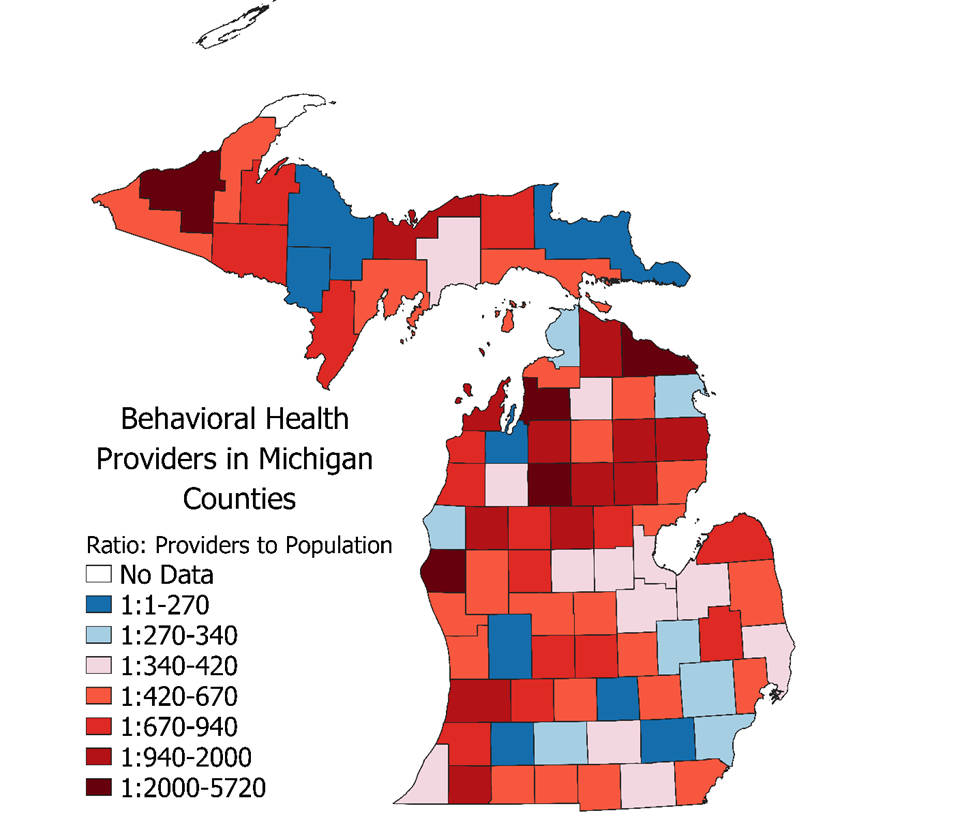
Access to care remains a major barrier. Michigan faces a significant shortage of behavioral health providers, with an average ratio of one provider per 360 residents.⁷ Of the state’s 83 counties, 68 experience provider shortages, and more than 40% of Michigan’s population lives in designated Mental Health Health Professional Shortage Areas (HPSAs)⁷ (Figure 1). Addressing these gaps would require an estimated 188 additional full-time providers.⁷
These challenges underscore the importance of continued advocacy, particularly during Mental Health Awareness Month, to improve access, equity, and outcomes for all Michigan residents.
Take Steps towards Improving your Mental Health!
Mental health is deeply interconnected with physical health. The most prevalent mental health conditions in the U.S. include anxiety (19.1%), depression (15.5%), substance use disorders (8.1%), post-traumatic stress disorder (4.1%), and bipolar disorder (2.8%).⁸
Individuals experiencing severe depression are at significantly higher risk—up to 40% greater—of developing chronic physical conditions such as cardiovascular disease, diabetes, and metabolic disorders.⁸ This highlights the importance of early awareness and proactive self-assessment.
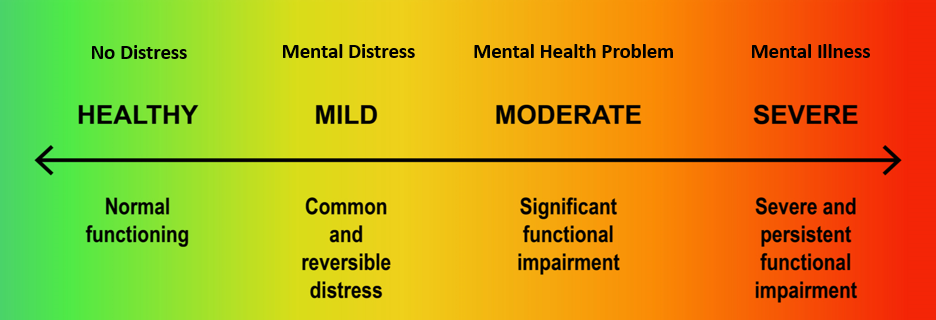
Know the Signs
People often feel stuck, confused, or misinformed when it pertains to managing mental health conditions. To improve awareness, follow 3 simple steps to learn, detect, and act today!
Step 1: Stay vigilant to common signs of mental distress shown in Figure 3.10 These signs were collected by the CDC and documented by behavior health specialists. Awareness helps detect issues early to reduce the severity of symptoms before they occur.
Step 2: Turn to a trusted family member or friend for support, to develop a support system dedicated to improving your mental health status.
Step 3: Seek and consult a medical professional to get a mental health screening to officially begin your road to recovery.
Michigan’s Response and Path Forward
Addressing mental health requires a comprehensive approach that extends beyond clinical treatment. While medication and therapy are essential, long-term well-being also depends on supportive environments, prevention strategies, and policy innovation.
Healthy Habits Beyond Clinical Care:
- Practice mindfulness or meditation
- Maintain strong social connections
- Limit excessive screen time and social media use
- Establish consistent sleep routines
- Follow a balanced diet
- Engage in regular physical activity
Policy and System-Level Efforts
Ongoing policy developments, such as updates to Medicaid coverage in Michigan, aim to expand access to mental health services—particularly for individuals with lower-acuity needs.¹¹ Continued investment in workforce development and integrated care models remains essential.
Trusted Resources and Support
- Seek care from licensed professionals, including psychologists, counselors, and clinical social workers
- Access local and statewide support services through Michigan-based programs¹²
- For immediate assistance, contact the 988 Suicide & Crisis Lifeline or Michigan’s Crisis & Access Line (MiCAL), both available 24/7
Take Charge of your Mental Health today!
Mental health is foundational to overall well-being—shaping how individuals think, feel, and function in daily life. This year’s theme, “More good days, together,” emphasizes the importance of connection, self-care, and collective action. Reducing stigma, improving access, and fostering supportive communities are shared responsibilities. By increasing awareness and taking proactive steps, individuals and communities can work together to build healthier, more resilient futures.
References
- Centers of Disease Control and Prevention. (2025, June 9). About Mental Health. Mental Health. Retrieved May 28, 2026, from https://www.cdc.gov/mental-health/about/index.html
- Mental Health America. (2025). The State of Mental Health in America. Retrieved May 29, 2026, from https://mhanational.org/wp-content/uploads/2025/09/State-of-Mental-Health-2025.pdf
- Akkas, F., & Corr, A. (2022, May 2). Mental Health Conditions Can Contribute to Suicide Risk. Retrieved April 5, 2026, from https://www.pew.org/en/research-and-analysis/articles/2022/05/02/mental-health-conditions-can-contribute-to-suicide-risk
- Columbia University Irving Medical Center. (2023, September 27). Substance Use Disorder and Mental Illness Often Go Hand in Hand. Both Must Be Addressed. Columbia University Department of Psychiatry. Retrieved April 6, 2026, from https://www.columbiapsychiatry.org/news/mental-health-and-substance-use-disorders-often-go-hand-hand-both-must-be-addressed
- Meharry School of Global Health. (2024, May 15). Mental Health Inequities Cost More Than $477 Billion Today and Could Increase to $14 Trillion by 2040 if Unaddressed, According to Analysis by Deloitte and Meharry School of Global Health. Retrieved April 6, 2026, from https://meharryglobal.org/mental-health-inequities-cost-the-us-more-than-477-billion-today-and-could-increase-to-14-trillion-by-2040-if-unaddressed-according-to-analysis-by-deloitte-and-meharry-school-of-global-health/#:~:text=Key%20takeaways,to%20improve%20overall%20well%2Dbeing
- National Alliance on Mental Illness. (2025). Mental Health in Michigan. Retrieved April 10, 2026, from https://www.nami.org/wp-content/uploads/2025/05/Michigan-GRPA-Data-Sheet-8.5-x-11-wide.pdf
- Citizens Research Council of Michigan. (2022, January 18). Michigan (Still) Falls Short on Mental Health Services. Retrieved April 6, 2026, from https://crcmich.org/michigan-still-falls-short-on-mental-health-services
- National Alliance on Mental Illness. (2025). Mental Health By the Numbers. Retrieved April 16, 2026, from https://www.nami.org/mental-health-by-the-numbers/
- BCcampus. (2021).The Language of Mental Health. Retrieved April 16, 2026, from https://opentextbc.ca/studentmentalhealth/chapter/the-language-of-mental-health/
- National Alliance on Mental Illness. (n.d.). Common Warning Signs of Mental Illness. Retrieved April 17, 2026, from https://www.nami.org/wp-content/uploads/2023/11/NAMI-Warning-Signs-FINAL.pdf
- Michigan Department of Health and Human Services. (2026, February 27). Bulletin: Michigan Medicaid Policy (MMP). Retrieved April 17, 2026, from https://www.michigan.gov/mdhhs/-/media/Project/Websites/mdhhs/Assistance-Programs/Medicaid-BPHASA/2026-Bulletins/Final-Bulletin-MMP-26-08-Updates.pdf
- OK2SAY. (2026). Mental Health: Ways to Get Help. Retrieved April 19, 2026, from https://www.michigan.gov/ok2say/ways-to-get-help
Updated 05/13/2026